

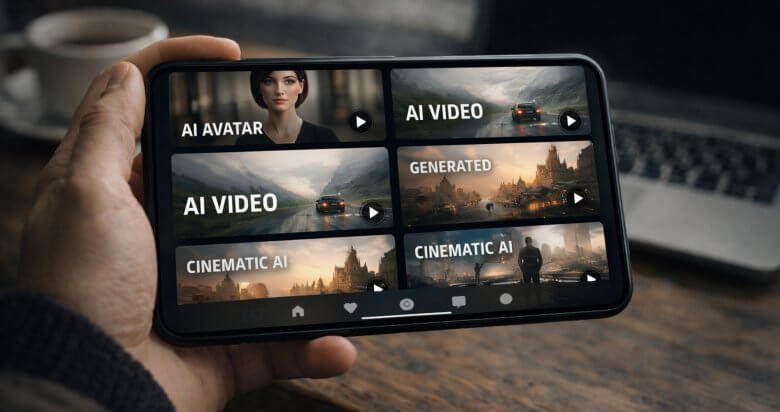
AI video is everywhere right now.
You see it on social media. You hear people talking about it. And at some point, you probably thought to yourself, “Yeah… I should be using AI video in my business.”
And yet — you’re not.
Not because you don’t want to.
Not because you’re lazy.
Not because you’re bad with technology.
It just never quite happens.
And here’s the interesting part: you’re not alone. A huge number of business owners want to use AI video, but only a small fraction are actually doing it.
This isn’t a coincidence. And it’s not what most people assume.
Once you zoom out and look at the patterns, the resistance around AI video starts to make a lot more sense.
Why picking the “right tool” rarely gets you started
One of the most common assumptions I hear is this:
“Once I figure out which AI video platform to use, then I’ll get started.”
On the surface, that sounds reasonable. After all, tools matter… right?
But this is usually where things quietly break down.
For most people, the problem shows up before software even enters the conversation. The real sticking point isn’t which platform to choose. It’s a more basic question:
What are you actually trying to do with AI video?
If you’ve never used AI video before, that’s not an easy thing to answer. And when people get stuck there, they often do something that feels productive — but isn’t.
They focus on the software.
They watch demos.
They compare platforms.
They poke around.
Messing with tools feels like progress. It gives you the sense that you’re “working on it.”
But it also lets you avoid the harder question: where AI video actually fits in your business.
So you keep telling yourself you just need to find the right platform, when in reality that search is often a diversion from answering what really matters.
The platform problem that creates a second stall
Let’s say you have done some thinking.
You have a rough idea of where AI video might fit. You know what you want it to help with. Now comes the next step — picking a platform.
And this is where a second point of resistance kicks in.
Because the moment you start looking around, you realize there isn’t just one option. There are dozens.
One does text-to-video.
Another focuses on avatars.
Another promises cinematic results.
Suddenly, you’re no longer asking how AI video fits into your business. You’re asking:
“Which AI video platform is the right one?”
And of course, you don’t want to make the wrong choice.
So you slow down.
You research more.
You tell yourself you’ll come back to it later.
Every platform has pros and cons. And when you’re trying to decide which one is “best,” hesitation feels justified. But what often happens is you end up stuck in another mental loop — gathering information without ever moving forward.
When examples quietly raise the bar too high
Now let’s assume you’ve made it this far.
You’ve thought things through. You’ve looked at platforms. You’ve even picked one that seems reasonable for your situation.
The next thing most people do is look for examples.
They open YouTube.
They scroll social media.
They see AI videos everywhere.
And a lot of what they see looks amazing.
Cinematic shots.
Perfect lighting.
Videos that look like they required a full production team.
Without realizing it, that’s where the bar gets set.
Instead of asking, “Would this be useful for my business?” the question quietly shifts to:
“Can I make something that looks like this?”
That’s the trap.
Because most businesses using AI video aren’t creating flashy, cinematic content. They’re creating practical videos.
Short. Specific. Often kind of boring.
They’re not trying to impress anyone. They’re just trying to explain something or answer a question.
But once you’ve seen all those polished examples online, it’s easy to set the bar far higher than it needs to be. And when the goal becomes “impressive” instead of “useful,” a lot of people never finish — or even start — a video at all.
How “doing it right” turns into doing nothing
There’s one final pattern that quietly kills AI video for a lot of businesses.
At some point, people start thinking:
“If I’m going to do this, I need to do it right.”
Go big or go home.
That’s when things start to spiral.
Instead of thinking about making one useful video, they start thinking about building a whole system.
A content strategy.
A repeatable process.
A library of videos.
Something they’ll have to maintain over time.
What started as a small experiment suddenly feels like a major commitment.
It’s a lot like exercise.
Many people avoid working out because they assume it means joining a gym, buying new clothes, finding the perfect routine, and committing to five days a week.
When in reality, the first step could just be putting on your shoes and going for a walk.
AI video works the same way.
One useful video is doable. Turning AI video into an ongoing “thing” for your business starts to feel complicated and time-consuming.
So people tell themselves they’ll come back to it later. When they have more time. When they can plan it properly.
And of course, that moment never arrives.
Why this isn’t a motivation or tools problem
When you step back and look at all of this together, a clear pattern emerges.
This is not a motivation problem.
It’s not a creativity problem.
And it’s definitely not a tools or software problem.
Most people don’t fail at AI video. They never really get out of the gate — because their expectations were off from the start.
They try to pick tools before they’re clear on what type of video they want to make.
They keep postponing decisions instead of choosing one small direction.
They judge business videos by what looks cool instead of what’s useful.
They expect the first real use of AI video to feel exciting, when well-done business videos are often mundane.
When you think about it this way, the resistance around AI video actually makes sense.
Not because anything is wrong with you — but because the way most people think AI video is supposed to work doesn’t match real life.
A clearer way to think about starting
Once you see these patterns clearly, the whole situation around AI video changes.
Not because it suddenly becomes easy. And not because the challenge magically disappears.
But because the internal resistance you’ve been feeling finally makes sense.
And when something makes sense, it becomes much easier to move forward — one small, useful step at a time.

