

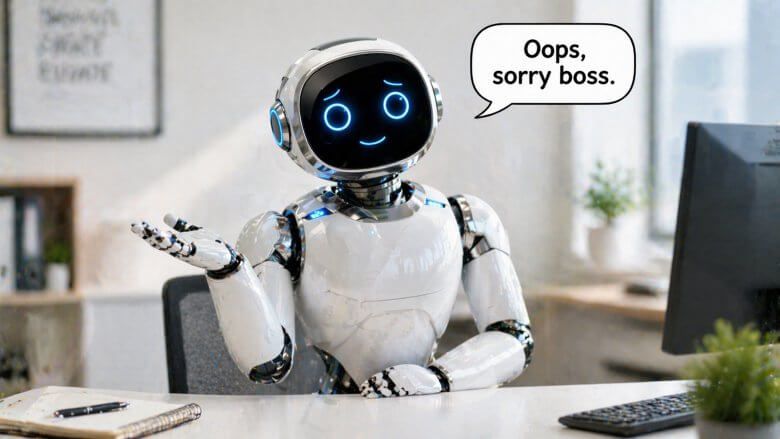
Most AI mistakes don’t look like mistakes at first.
That’s what makes this topic so tricky.
If AI gave you a blatantly ridiculous answer every time it messed up, this would be easy. You’d laugh, close the window, and move on with your day.
But that’s not how it usually works anymore.
Today’s AI tools are incredibly impressive. In many cases, they’re helpful, fast, and surprisingly accurate. They can save time, organize your thinking, and help you move through work faster than you could on your own.
That’s the good news.
The bad news is that when AI does get something wrong, it often doesn’t look wrong in the moment. It can sound polished, confident, and completely believable while quietly sending you down the wrong path.
And that can cost you a lot more than a bad answer.
It can cost you time. Money. Energy. Momentum.
In this post, I want to show you two real-life examples where trusting AI too much burned me — and then I’ll walk you through the simple 3-step process I now use to pressure-test AI before I run with what it tells me.
No coding. No jargon. No techie gymnastics.
Just a practical way to use AI more wisely without throwing the tool out altogether.
The real problem with AI today
Back in the early days of AI, one of the big problems was obvious hallucinations.
It would just make stuff up.
That still happens occasionally, but it’s a lot rarer than it used to be. Most AI tools today are pretty accurate most of the time. That’s part of why they’ve become so useful.
But that also creates a new problem.
The bigger issue now is not that AI constantly gives you goofy, fake answers.
The bigger issue is that AI can give you an answer that sounds polished, sounds smart, sounds totally believable… and still be wrong in a way that wastes your afternoon.
That’s a very different kind of risk.
Because when AI leads you off course, it’s not the AI that takes the hit.
You do.
Real-life example #1: the marketing strategy that looked good on paper
Let me give you a real example.
Over the past year, I used AI to help me create 4 different marketing campaigns. And like a lot of people, I gave AI a little too much credit.
I figured, hey — this thing has access to all kinds of information. It can analyze patterns faster than I can. It probably sees things I don’t.
So in a weird way, it almost felt like I had a secret competitive advantage just by using it.
So I went with it.
I followed AI’s recommended strategy. I built the campaigns. I spent weeks putting the pieces together. In some cases, I even put actual ad dollars behind them.
And then I launched those campaigns.
Crickets.
Nothing happened.
That was a pretty jarring moment, because I had followed the directions exactly. I did what AI told me to do, and I fully expected at least some activity.
But nothing.
That’s when it really hit me: AI can give you a polished plan that sounds smart, feels believable, and looks good on paper — but still doesn’t work in the real world.
Now, in fairness, this was not all AI’s fault.
Part of the problem was that the market had shifted. What used to work even 2 or 3 years ago was not working the same way anymore.
So in a sense, AI was looking in the rearview mirror.
It was recommending things that had worked recently and just assuming those same strategies would still work today.
And that’s where this gets interesting.
AI was not “dumb” in that situation.
The plan was technically coherent.
The logic held together.
The problem was that the plan was out of step with what the market was doing right now.
That is a very important distinction.
A lot of people assume AI errors are mostly factual errors. Wrong numbers. Wrong names. Wrong details.
But sometimes the bigger miss is strategic.
AI can hand you a plan that sounds sharp and sensible while completely missing the fact that buyer behavior has changed, attention has shifted, or demand has softened.
That’s a costly kind of wrong.
Why believable wrong answers are more dangerous than obvious wrong ones
The reason I’m sharing that example is not just because AI was wrong.
It’s because AI was wrong with confidence.
And that’s what makes this so tricky.
When something sounds polished, smart, and believable, your guard naturally comes down. You stop double-checking. You stop questioning it. You just assume that if it looks good and sounds reasonable, it’s probably right.
That’s where you can get into trouble.
Because when AI gives you an answer that is obviously incorrect, you can catch it right away.
But when AI gives you an answer that looks good and sounds believable, you can waste a ton of time before you realize you were going in the wrong direction.
That’s the trap.
Real-life example #2: the software recommendation that wasted an afternoon
Here’s another real-life example.
Recently, I was using AI to help me customize a software tool because I wanted it to do something specific.
So AI started giving me detailed, step-by-step instructions like it knew the software and knew exactly what it was talking about.
And once again, it sounded credible.
It sounded believable.
So I trusted it and followed the recommendations.
Then I spent hours working through those instructions. Clicking around. Trying different things. Adjusting settings. Going back and forth with AI.
Only to find out that the thing AI was telling me to do was not actually possible.
That was the most frustrating part.
This was not some quick little mistake I caught in 2 minutes.
I burned through 4 or 5 hours on this and wasted an entire afternoon.
And in the end, even the AI basically admitted that what it had been recommending wasn’t actually possible.
That’s the kind of thing you need to be on guard for.
Once again, this was not an answer that looked immediately and obviously wrong.
AI gave me a detailed, confident recommendation for something that sounded completely plausible and doable.
But that wasn’t the case.
This is another form of AI failure people don’t talk about enough.
Sometimes it’s not bad strategy.
Sometimes it’s a technical recommendation that sounds perfectly legit but turns out not to be possible after all.
And if you don’t have a way to pressure-test that kind of recommendation, you can burn a shocking amount of time before you realize the problem is not you.
The problem is the advice.
The bigger truth: AI has no skin in the game
Both of those real-life examples point to the same bigger truth.
AI can be incredibly helpful. It can save you time. It can organize your thinking. It can help you work faster.
But here’s the important part:
AI has no skin in the game.
If AI gives you a strategy that flops, it doesn’t lose sleep over it.
If it sends you chasing a software fix that isn’t possible, it doesn’t lose an entire afternoon.
You do.
That matters.
Because yes, AI can help you do the work.
But it does not feel the consequences of the work.
It does not have judgment.
It does not have intuition.
And it definitely does not have anything at risk.
That does not mean AI is bad.
And it definitely does not mean you should stop using it.
I use AI all the time.
But when AI gets something wrong, it usually doesn’t raise its hand and warn you. Most of the time, it sounds completely confident.
That is exactly why you need a way to pressure-test what it tells you — especially when time, money, or resources are on the line.
A simple 3-step process to catch bad AI recommendations earlier
This does not have to become some giant, complicated system.
You do not need to become a programmer.
You do not need to “master prompt engineering.”
You just need a few practical habits that help you catch those moments when AI sounds confident but might be quietly leading you down the wrong path.
Here are the 3 checks I use.
1. The Phantom Check
Use the Phantom Check anytime AI gives you technical recommendations, software advice, or tells you how to do something inside a specific platform.
What you do is simple: ask AI to show you the official documentation URL or the source where it is getting that information.
In plain English, you’re basically saying, okay, prove it.
Show me where this is coming from.
Because if AI can’t point to a real source, that’s a caution flag.
It might be describing a phantom feature, a made-up workflow, or something that sounds real but doesn’t actually exist.
This one is especially useful with software tools, plugins, online platforms, and anything technical where a feature either exists or it doesn’t.
If the recommendation matters, make AI show its work.
2. The Skeptical Auditor
Use this when AI gives you a marketing idea, a business recommendation, or some kind of strategy.
Here, the move is to ask AI to play devil’s advocate and identify the 3 biggest risks or problems with the idea it just gave you.
What could go wrong?
Where is the weak spot?
What assumptions is it making?
This works because AI is often very good at generating the best-case version of an idea.
What it often does not do automatically is stress-test that idea unless you specifically ask it to.
So if AI just gave you a strategy that sounds brilliant, slow down and ask it to argue against itself.
That one little move can save you a lot of wasted motion.
3. The Context Reset
Use the Context Reset when you’ve been in a long conversation with AI and want to make sure the chat has not drifted off course.
This is one of my favorites.
You simply stop and say something like: this chat thread is getting pretty long. Let’s pump the brakes for a second. Please give me a quick summary of what we’ve been discussing so I can make sure we’re still in sync.
That matters because sometimes you start off trying to solve one problem, and 20 minutes later the conversation has quietly drifted into something else.
No alarm bells.
No dramatic warning.
Just subtle drift.
And if you don’t catch that drift, you can end up spending a bunch of time solving the wrong problem.
The Context Reset helps bring the conversation back into focus before that happens.
This is not about using less AI
It’s really important to say this plainly:
The point here is not that AI routinely gives you bad information.
In my experience — and I use AI nearly every single day — it gives good information and useful recommendations the vast majority of the time.
That’s why it’s so helpful.
But that does not mean it is right 100% of the time.
And that’s the key point.
Because when AI gets it wrong, it can cost you time, money, and energy you can’t get back.
So yes, use AI.
Offload some of your work to it.
Let it help you think better and move faster.
Just don’t hand the keys to AI and assume it always knows where it’s going.
Why this matters more now than it did a year ago
As AI tools get better, this issue actually becomes more important — not less.
Why?
Because the more polished AI becomes, the easier it is to trust.
And the easier it is to trust, the easier it is to follow a bad recommendation farther than you should.
That’s why this is no longer just a “hallucination” problem.
It’s a judgment problem.
It’s a discernment problem.
It’s a “don’t confuse confidence with correctness” problem.
And that is exactly the kind of mistake busy people make when they are moving fast and trying to save time.
In other words, the better AI gets, the more important your filters become.
That may sound backwards, but it’s true.
Final takeaway
AI is a powerful tool.
It can absolutely save you time.
It can help you think better, move faster, and get unstuck.
But when it gets something wrong, it often does not look wrong right away.
That’s the part you have to watch out for.
So keep using it.
Just pressure-test it.
A few extra seconds of skepticism up front can save you hours of frustration later.

